

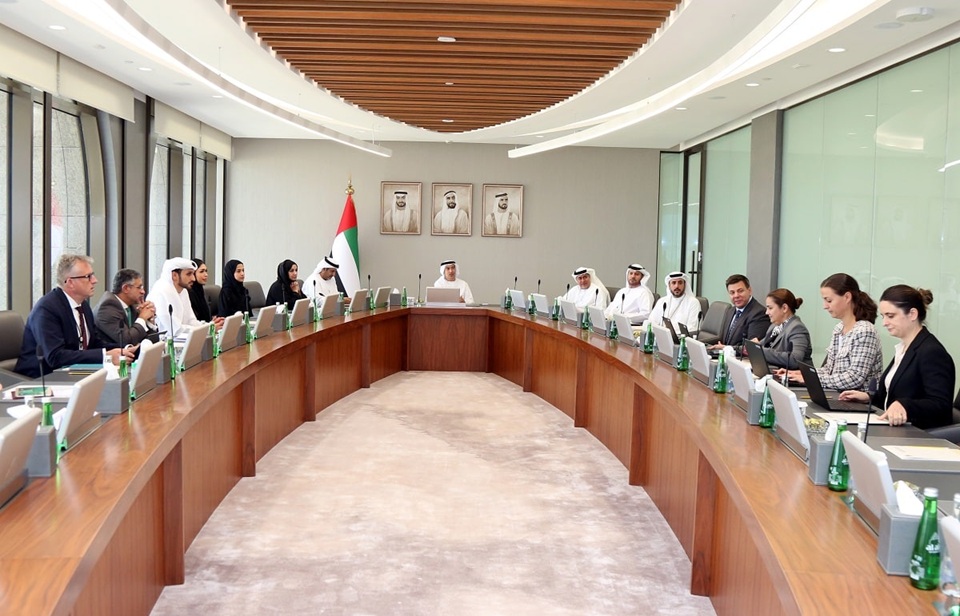
An IMF ( International Monetary Fund) statement after an IMF staff team led by Mr. Said Bakhache team visited the UAE, has commended the country on its enhancements to the AED Dirham monetary framework, and the progress in the rollout of the Digital Dirham CBDC project as well as its proactive stablecoin regulations. The IMF statement called on modernization efforts to continue to include careful assessment of risks while promoting local capital market developments.
In August 2025, The Central Bank of UAE announced it was preparing itself to launch Digital Dirham, its CBDC ( Central Bank Digital Currency) by the end of the year. As per the press release, The CBUAE is moving towards officially launching the national central bank digital currency (CBDC) in the near term.
The report covered the design principles and policy frameworks that have shaped the development of the Digital Dirham, ensuring it was in line with best practices and standards issued by the International Monetary Fund (IMF) and the Bank for International Settlements (BIS).
The digital Dirham will be will allow online and instore and commercial peer-to-peer transactions. Furthermore, the CBUAE has developed a comprehensive platform for issuing, trading, and using the digital dirham, including the digital wallet, which enables individuals and businesses to conduct financial transactions.
When it came to crypto the IMF statement noted that while the UAE is growing as a global hub for virtual assets, this should be supported by continued strong coordination among regulators to monitor risks and developments. The IMF statement noted, “Ongoing efforts to continue alignment with international regulatory standards and strengthen supervisory capacity are welcome and will be critical to safeguarding financial stability while promoting responsible innovation. We welcome the major efforts under the National AML/CFT Strategy and Action plan that resulted in the recent removal of the UAE from enhanced monitoring under the Financial Action Task Force and encourage continued progress.”
In September 2025, United Arab Emirates (UAE) Ministry of Finance signed a Multilateral Competent Authority Agreement (MCAA) and joined the global Crypto-Asset Reporting Framework (CARF). The UAE framework is scheduled to roll out in 2027, and then the UAE is expected to start sharing data with international tax authorities in 2028.
CARF provides an international standard for the automatic exchange of crypto-asset-related information between tax authorities and is part of the global standards in the exchange of information for tax purposes. Close to 70 jurisdictions have committed to implementing CARF, with most preparing for their first information exchange in 2027 or 2028.
The IMF praised the UAE resilience to global uncertainty and regional tensions, and noted that the financial sector remains strong and sound, while emphasizing that the UAE should monitor external shocks, real estate price developments and cybersecurity which is needed.
As per the statement as well, The UAE is projected to grow strongly well above global average in 2025 GDP is projected to expand by 4.8 percent in 2025, driven by robust non-hydrocarbon growth and a rebound in hydrocarbon output as OPEC+ production increases, accelerating further to 5.0 percent in 2026.
It also noted that expansion in tourism, construction, and financial services continues to underpin growth, supported by major infrastructure projects. Inflation is projected at 1.6 percent in 2025 and around 2 percent over the medium term. Housing costs are expected to be the main source of price pressures, raising potential affordability concerns, while tradable remain subdued.
The IMF also noted that UAE’s financial sector remains strong and sound, with banks remaining profitable, while UAE banks’ exposure to the sector has gradually declined to about 18% percent of risk weighted assets.